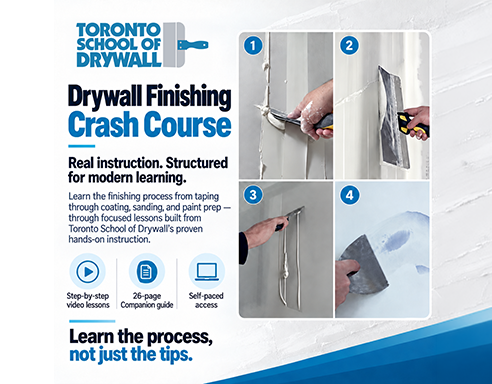
A Different Approach to Drywall Training

Toronto School of Drywall was built around a simple idea: drywall skills can be taught systematically, practically, and to a measurable standard.

From its original classroom and hands-on training programs, TSD developed a structured approach to drywall education that combined demonstration, guided practice, skills assessment, industry involvement, and real-world application.

The way people learn — and the environment surrounding skilled-trades training — has changed considerably since then. TSD is now bringing selected training back into use while exploring how that original approach can inform the next generation of drywall skill development.

Built in the Classroom. Proven in Practice.

TSD’s original programs combined structured skill development, hands-on instruction, real-world practice, and measurable assessment. Students learned not only how to perform drywall-finishing techniques, but why each step mattered and how the complete process worked together.

Skills were tracked individually through the TSD Skill Passport, while practical training extended beyond controlled classroom exercises into real project environments. The result was an intensive 10-week program designed to prepare students for entry-level employment — with outcomes that validated the effectiveness of the model.

That process-based approach went on to shape TSD’s work with students, employers, manufacturers, retailers, media organizations, and international training partners.

  • 21

    Tracked Skills

  • 10

    Weeks

  • 90%

    Employment Rate

Toronto School of Drywall students in an original classroom training session with tools and course materials.
Toronto School of Drywall Skill Passport pages used to structure and track drywall finishing skills.

When the Model and the Rules No Longer Fit

Toronto School of Drywall was never designed as a conventional vocational school.

Theory was taught in the classroom, but much of the hands-on learning took place in carefully selected real-world environments. Students developed their skills on actual projects, under changing conditions, where judgment and problem-solving mattered. It was an unconventional model — and the results showed that it worked.

Eventually, TSD’s use of carefully selected real-world training sites for hands-on instruction came into conflict with the regulatory framework governing vocational schools, which was built around a more traditional model where training was centred at the school itself. TSD faced a choice: reshape the program to fit that framework, or stop delivering it. We chose not to compromise the approach that made the training effective.

TSD Today

Today, TSD is moving forward along three connected paths — practical training available now, a new model for career-level skill development, and renewed industry collaboration.

about training available now

Practical Training Available Now

Selected TSD training is already available online for DIYers, handymen, building maintenance and renovation professionals, general contractors, and retail staff.

about career training

Career-Level Training Reimagined

TSD is developing a new approach to professional drywall skill development for a technology-rich, flexible learning environment — not simply recreating the old physical-school model online.
about industry

Industry Collaboration & Innovation

TSD is renewing its collaborative work with manufacturers, suppliers, retailers, and other industry partners in training, product understanding, testing, research, and innovation.